
When a home is being sold, the electrical system gets a hard look — from inspectors and from insurance underwriters. These are the key electrical issues that arise during the sale of a home, and what a 4-point inspection — the kind Citizens Property Insurance’s underwriting team relies on — actually asks about the electrical system.
Citizens Property Insurance publishes a public sample 4-Point Inspection Form — the minimum detail its underwriting team needs on four systems in a home: roof, electrical, HVAC and plumbing. A Florida-licensed inspector completes and signs it.
On the electrical side, the form asks for the panel type — circuit breaker or fuse — the total amps and whether that amperage is sufficient for the home’s current usage, wiring types such as cloth or knob-and-tube, and any visible hazards: double taps, scorching, loose or exposed wiring, improper grounding, improper breaker size, over fusing and more. By the form’s own definition, acceptable condition means the system is working as intended with no visible hazards or deficiencies.
Below are the key points we want every Realtor to know.

This one has been well covered over the years: circuit breakers are superior to fuses in that they’re resettable and reliable. Just because a home has a fuse panel doesn’t mean it has to be replaced. The big asterisk, though, is that insurance companies are not happy with fuse panels — panel type, circuit breaker or fuse, is the first thing the 4-point form asks about the electrical system, and blowing fuses and over fusing both sit on its hazard checklist.
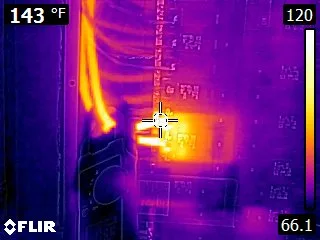
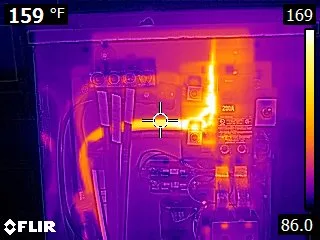
Summer pushes Florida panels hard — and equipment mounted outdoors runs hotter than anything inside the house. A thermal camera makes that trouble visible: these two images from our own inspections show a bad breaker at 143 °F and a bad buss connection at 159 °F. Neither shows up in a listing photo or to the naked eye, but both are exactly the kind of issue an inspection can surface mid-sale. Finding them early keeps a small repair from becoming a negotiation problem.
Everything in our world degrades and eventually needs to be replaced — and it takes a professional to know when that time is. Just because a home has cloth wiring doesn’t mean it’s in imminent danger. What we do want to confirm is that it hasn’t degraded and that it’s properly protected by the right overcurrent protection (breaker size). We always suggest rewiring with modern cabling, but if that doesn’t fit the budget, there are alternate methods — installing arc-fault and dual-function circuit breakers. Cloth wiring is one of the wiring types the 4-point form specifically asks the inspector to flag.
Aluminum wiring isn’t inherently bad, but it’s not ideal either. Aluminum expands roughly 30% more than copper when under full load, exposed aluminum reacts instantly with oxygen to form aluminum oxide — an electrical insulator — and single-strand aluminum, the kind commonly found in early-70s homes, is significantly softer and more brittle than copper. Remediation methods approved by Citizens Insurance include AlumiConn connectors — a mechanically approved alternative using set-screw lug connectors filled with anti-oxidant compound to join aluminum branch wire to copper pigtails safely — or complete rewiring: replacing all branch circuits with modern NM-B copper cable, the most thorough solution, though often cost-prohibitive due to drywall cutting and labor.
Modern aluminum wire uses 8000-series alloy, which incorporates trace amounts of iron and silicon. That drastically reduces thermal creep and increases tensile strength, making the wire far less prone to loosening — however, improper installations have shown premature failures that wouldn’t normally be found on copper wiring.
Multi-strand aluminum dominates residential and commercial applications where large amounts of power need to travel long distances cost-effectively, and these cables don’t have the same expansion issues commonly found in single-strand cable — however, copper is always better. You’ll see multi-strand aluminum in:
When safety comes into question, we can only be swayed one way — this is a must upgrade. Most older grounding systems used the copper water pipe coming into the home as the grounding electrode: the metallic object that carries fault current to earth and dissipates it. The biggest reason these fail is that after 50 years the connectors have corroded or fallen apart, and in most cases the pipes have been abandoned or cut off during a repipe of the home — meaning they’re no longer in continuity with earth. A modern grounding system is an inexpensive upgrade that can save a lot of headaches with lost neutrals, and it keeps a family safe by allowing fault current to safely reach the earth instead of passing through hazardous alternatives. Improper grounding is a named hazard on the 4-point form.
NEC 2020, Article 230, mentions surge protection requirements for new homes: it’s now required for panel and service upgrades as well as new construction. The code mandates a minimum, and the minimum doesn’t always meet the best-case scenario for the service — so we consult with the engineering team at the surge protection manufacturer to provide the best product for the service we’re working on.
One thing that misleads customers: a surge protector at the service or panel is expected to stop every surge from hurting anything in the home. That’s not how it works. Surge protection is a multi-level process — protectors at the service are there to protect large non-variable-speed motors and wiring, while specific equipment needs surge protectors of its own.
Water and electricity generally don’t mix — but we occasionally need electricity to create light around water. GFCI protection is required on everything in and around bathrooms, pools and docks, and close to required on almost everything else in a residence. The key topic the everyday electrician misses is bonding: pools, whirlpool tubs and docks all require bonding in today’s code. Finding a few missing weatherproof covers or GFCIs in the garage or on the exterior of the home is a good catch — but the biggest safety hazard is poor bonding on components where water is involved.
There are many more topics to cover when discussing proper electrical systems in homes, but it’s always beneficial to hire an electrical contractor to inspect the home prior to sale — and we strongly believe that statement for any type of system in a home. Hire a plumber to inspect the plumbing, hire an HVAC contractor to inspect the air conditioning system, and so forth. Citizens’ own inspector guidelines note that a trade-licensed professional may sign off on the section of the 4-point form for their trade — an electrician, for the electrical section.
From the Gulf beaches to Tampa Bay, our licensed electricians are active across every Pinellas community.
Every form gets a 24-hour response — usually same day. Or call now and talk to someone who actually does the work.